
BLUETTI AC200PL
7.5Very good · out of 10See current price ↗- Stated: 2,304 Wh · 2,400 W output
- Portable power stations
Product images: Amazon listings
If you're after a 2,304 Wh battery, the BLUETTI AC200PL delivers, with 2,400 W continuous and a LiFePO4 battery (3,000 cycles stated) on top. It suits home backup that can grow into a bigger system, and its sibling listing, the BLUETTI AC180, holds #1 in our power station for USB-C laptop charging ranking.
Each variant has its own page.
| Brand | BLUETTI |
|---|---|
| Category | Portable power stations |
| Battery capacity | 2,304 Wh (stated in the Full listing title, not verified against manufacturer documentation) |
| Continuous output | 2,400 W (stated in the Full listing title, not verified against manufacturer documentation) |
| Charge cycles (stated) | 3,000 |
| Outputs named in the listing | 11 |
| ASIN | B0D17CW6KK |
Full listing title: BLUETTI AC200PL Portable Power Station 2304Wh 2400W LiFePO4 Solar Generator
Rated from the listing's specs, no buyer reviews yet
What it's made for: home backup that can grow into a bigger system.

The two power stations closest to it on our rating, with a dated price.

Battery capacity stated in the listing, next to 2,400 W of continuous output. Plan on roughly 1,958 Wh at the outlet after conversion losses (our 0.85 rule of thumb).
What it has going for it
2,304 Wh battery. At a steady 100 W that is roughly 19.6 hours, after the usual conversion losses (our 0.85 rule of thumb). Enough to carry the fridge, the router and the lights through a long evening and well beyond, if your load list adds up.
2,400 W continuous. Continuous watts decide what can run at the same time; motor loads also need headroom for the second a compressor or a pump kicks in. A kettle or a microwave can run too, as long as its label stays under that figure.
LiFePO4, 3,000 cycles. Rated for 3,000 charge cycles, per the listing. Even at one full cycle a week, it takes a long time before the battery becomes the weak point.
At home, 2,304 Wh is a reserve you can plan a long outage around.
At the campsite, it tops up from the car on the drive.
The seller states, word for word, in the BLUETTI AC200PL listing:
- The AC200P L features a 48V RV port for easy charging your RV battery and is compatible with solar panels, it offers convenient and green power replenishment.
- With a max 2400W AC input, AC200P L from 0-80% only takes 60min.
- AC200P L utilizes LiFePO4 batteries with 3000+ cycles, equaling a 10-year lifespan.
- Besides 4 2400W AC outlets, AC200P L also features a 30A TT30 port, a 48V/8A DC port, a car port, 2 100W PD and 2 15W USB-A, a total of 11 ports for all charging needs.
- BLUETTI AC200P L portable power station, AC charging cable, solar/car charging cable, XT90-aviation cable, user manual.
Their words and their figures.

What the BLUETTI AC200PL listing names:
In the box, per the listing: AC charging cable, Solar/car charging cable, XT90-aviation cable, User manual.
That is what the listing says comes with the BLUETTI AC200PL. Check the box on delivery day, before the cardboard goes out with the recycling.
Check your own plugs and your load list against it before you order.

We have no recent price on file for this listing, so we don't print an old one.
The button opens the exact listing (ASIN B0D17CW6KK), where today's price, stock and seller apply. Sizes and bundles of the same family often sit at different prices.

Need longer runtime? The EcoFlow DELTA Pro 3 + 400W Panel (8.1/10) states 4,096 Wh, a good deal more.
Want it to take over on its own? The Jackery Explorer 2000 v2 (8.7/10) names a UPS mode (20 ms).
Kettle or microwave on the list? The PECRON E3800 LFP (7.7/10) states 4,200 W continuous.
Our take
What we'd buy the BLUETTI AC200PL for is a 2,304 Wh battery, with 2,400 W continuous as a bonus. No buyer reviews yet, so this BLUETTI power station has to win you over on paper. The one thing that bugs us: no UPS or EPS function in the listing, while most picks here have one. We'd pick the BLUETTI if you want a long outage covered, fridge and freezer included; otherwise, put it next to the Anker SOLIX C2000 Gen 2 first.
Charge it to full from the wall, then plug in a lamp and one thing you really rely on, so you know how it behaves before you need it.
Move the essentials from the wall to the station, the fridge first. Watch the percentage for the first hour; it tells you more about your real runtime than any chart. Our rule of thumb says about 19.6 hours at 100 W.
It refills from the wall between outages, and from the car on the road. Know how you would top it up if the grid stays down for days.
Store it at the charge level the manual recommends and top it up every few months. LiFePO4 cells are relaxed about this, but every battery slowly self-discharges. Our storage guide has the routine.
Before you add the BLUETTI AC200PL to your cart: check your load list, because 2,304 Wh and 2,400 W continuous have to cover what you run at once and for how long, start-up spikes included.
Read the label on each device (or its manual) for its watts, note which ones have a motor, and multiply by the hours you need them. Our watts vs watt-hours guide shows the arithmetic.
Anything with a compressor or a motor pulls a short spike when it starts; our refrigerator guide shows how to check a fridge or a freezer.
Plan how you refill it in a long outage: the wall when power returns, panels, or the car. Our solar panel compatibility guide covers plugs and voltages.
A battery station gives off no exhaust, so it can sit indoors within the temperature range its manual gives. Our storage guide has a simple routine for the months between outages.
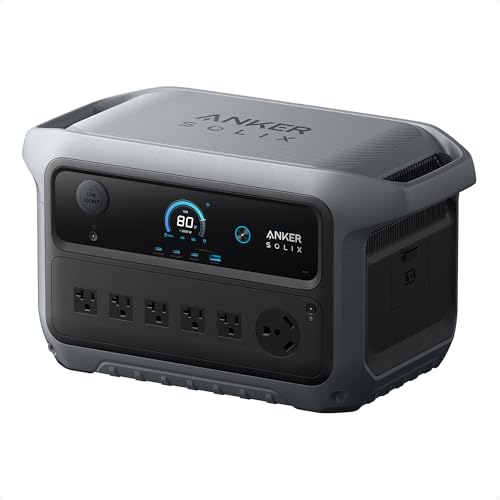
How the BLUETTI AC200PL stacks up against the closest alternative, the Anker SOLIX C2000 Gen 2.
| Criterion | BLUETTI AC200PL | Anker SOLIX C2000 Gen 2 |
|---|---|---|
| Our rating | 7.5/10 | 7.5/10 |
| Battery capacity | 2,304 Wh | 2,048 Wh |
| Weight | Not stated | 18.9 kg |
| LiFePO4 | Stated | Not stated |
| Expands to | Not stated | 4 kWh |
Both score 7.5/10. The Anker SOLIX C2000 Gen 2 adds less weight (18.9 kg) and more room to expand (4 kWh), while the BLUETTI AC200PL brings a bigger battery (2,304 Wh) and LiFePO4 cells.
We rate it 7.5/10 (very good). The rating comes from its documented listing alone, as no customer-review record is captured yet.
Its listing title states 2,304 Wh of battery capacity and 2,400 W of continuous output. Watt-hours decide how long it lasts; continuous watts decide what can run at the same time. These are the seller's figures, so check them against the manual.
Roughly 19.6 hours: 2,304 Wh × 0.85 for conversion losses ÷ 100 W. Idle draw, cold weather and battery age move the real figure, and our power runtime calculator works with your own numbers.
Its listing states 2,304 Wh of stored energy, 2,400 W of continuous output and LiFePO4 cells rated for 3,000 cycles. These are the seller's figures; how long it really lasts on your fridge and how loud the fan gets under load can't be read from a listing.
Your load list: read the label on each device (or its manual) for its watts, note which ones have a motor, and multiply by the hours you need them. Our watts vs watt-hours guide shows the arithmetic. The start-up spike: anything with a compressor or a motor pulls a short spike when it starts; our refrigerator guide shows how to check a fridge or a freezer. How you will recharge: plan how you refill it in a long outage: the wall when power returns, panels, or the car. Our solar panel compatibility guide covers plugs and voltages. Where it lives: a battery station gives off no exhaust, so it can sit indoors within the temperature range its manual gives. Our storage guide has a simple routine for the months between outages.
We link to the exact listing on Amazon, where today's price, stock and seller apply. It is an affiliate link, and it has no effect on the rating.